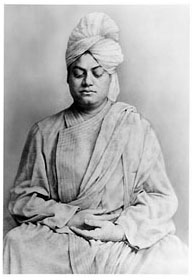
Swami Vivekananda and his mentor, Sri Ramakrishna Paramahamsa, have a profound and revered spiritual bond that has served as a source of inspiration for many individuals around the globe. Their narrative exemplifies a remarkable spiritual awakening and metamorphosis, showcasing the progression from skepticism to enlightenment.
The morning gathering
Vivekananda, initially known as Narendranath Datta, possessed exceptional intelligence and a curious nature. He was profoundly impacted by Western philosophy and science while simultaneously seeking spiritual enlightenment. During that time, he encountered Sri Ramakrishna at the Dakshineswar Kali Temple, located near Kolkata, in the year 1881.
The Initial Meeting
During their initial encounter, Narendra harbored doubts and desired to assess Ramakrishna’s credibility. The individual inquired directly of the wise person, “Have you had the experience of perceiving God?” Ramakrishna responded with a straightforward and uncomplicated manner, stating, “Indeed, I perceive Him with the same clarity as I perceive you, albeit in a more profound manner.” Narendra was greatly pleased by this intelligent answer, yet it did not entirely dispel his worries.
The Metamorphosis
Narendra consistently visited Ramakrishna and gradually became immersed in the saint’s spiritual sphere. Ramakrishna acknowledged Narendra’s inherent capacity and provided him with guidance in diverse spiritual practices. Under Ramakrishna’s instruction, Narendra underwent profound meditation states and encountered mystical experiences, leading to a gradual shift from skepticism to faith.
The pivotal moment
An important occurrence took place when Ramakrishna bestowed his own spiritual abilities upon Narendra, signifying that Narendra would become a prominent spiritual mentor in the future. Narendra experienced a spiritual encounter in which he felt the presence of a heavenly entity completely overpowering him, resulting in a state of deep bliss and understanding.
The Death of Ramakrishna
Ramakrishna died in 1886, leaving Narendra with the duty of carrying out his spiritual mission. Following Ramakrishna’s demise, Narendra made a commitment to monasticism and assumed the name Swami Vivekananda. He and his fellow pupils founded the Ramakrishna Mission, which is committed to serving humanity and disseminating the principles of their spiritual mentor.
The Global Mission
Subsequently, Swami Vivekananda embarked on a journey to the Western countries, with his most notable destination being the Parliament of the World’s Religions in Chicago in 1893. His address, commencing with the words “Sisters and brothers of America,” garnered him worldwide acclaim. He expressed ideas about the concept of universal brotherhood and the coexistence of many religions, reflecting the teachings of Ramakrishna.
The Legacy
The association between Vivekananda and Ramakrishna exemplifies the profound influence that a genuine guru-disciple relationship may have. Vivekananda propagated Ramakrishna’s teachings globally, which focused on the direct realization of God and the interconnectedness of all faiths. The Ramakrishna Mission persistently advances these principles by actively participating in spiritual, educational, and charitable endeavors on a global scale.
Overall, the narrative of Vivekananda and Ramakrishna is an extraordinary account of spiritual enlightenment, mentorship, and the all-encompassing message of affection and altruism. Their enduring influence serves as a source of inspiration for individuals who are in pursuit of spiritual development and a more profound comprehension of the divine.