— Alice's Adventures in Wonderland (1865), Chapter 6
About this quote
हिन्दी में
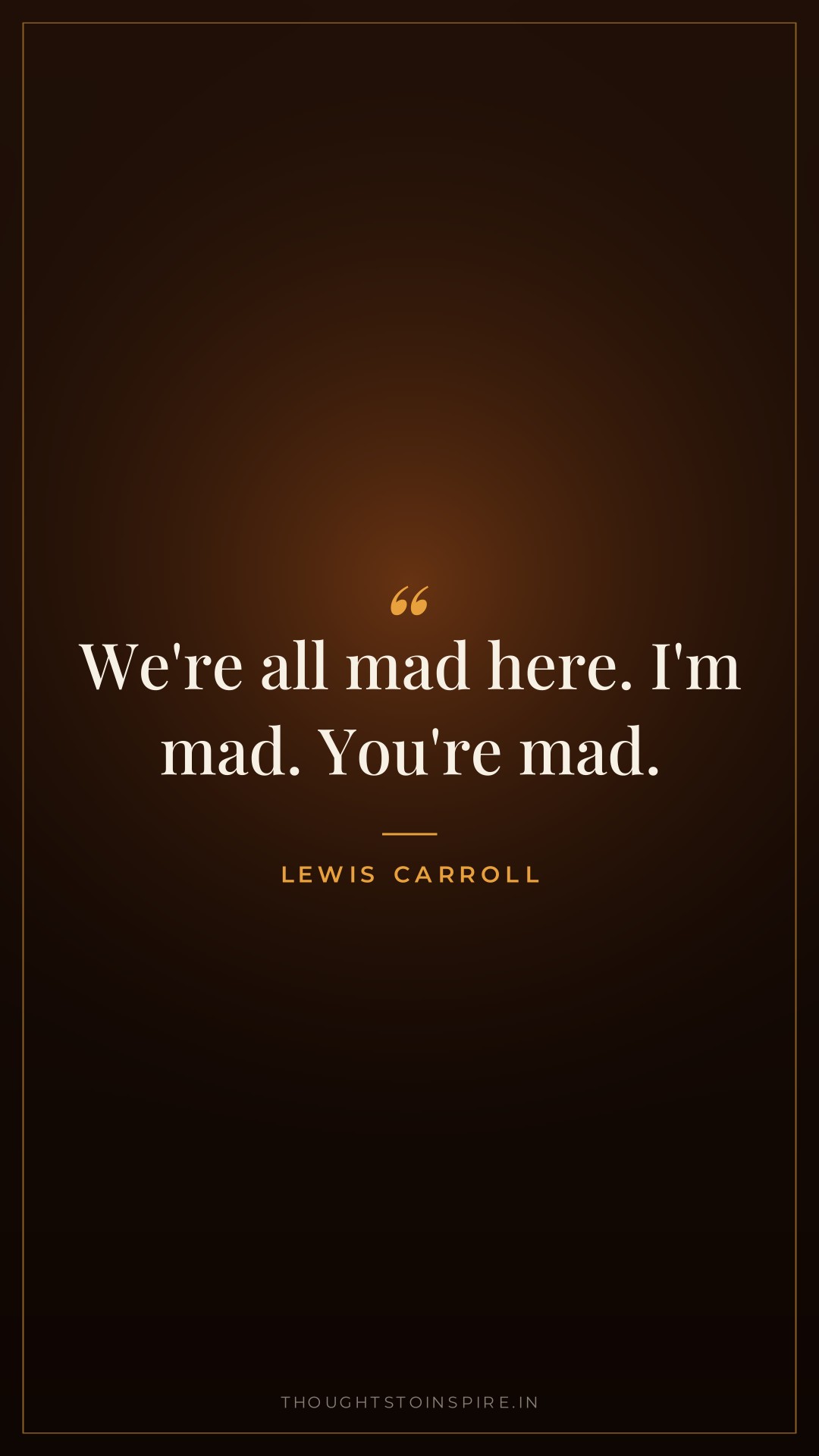
यहाँ हम सब पागल हैं। मैं पागल हूँ। तुम पागल हो।
What it means
Three flat declaratives, and the order does the work: the Cat files itself under the heading before it files Alice there. That is why the sentence arrives as an introduction to a place rather than as an insult — the speaker has already paid the entry fee. Nothing is being diagnosed about Alice in particular; madness is described as the local weather.
The line has since become a slogan for chosen eccentricity, printed on posters and worn as a badge, which turns it inside out. In the chapter, madness is not a personality anyone opts into; it is a property of the location, asserted as plain fact by a creature that is about to disappear. Worth keeping precisely because the cheerful version and the original point opposite ways: one is a boast about you, the other is a remark about where you have wandered.
What it teaches you
When someone tells you everybody here is like this and puts themselves in the category first, notice that the self-inclusion is what makes the claim hard to push back on — it removes the appearance of judgement without removing the judgement. Ask what is actually being described: the people, or the place that has collected them.
अर्थ और सीख
बिल्ली पहले खुद को पागलों में गिनती है, फिर ऐलिस को — इसी क्रम के कारण यह बात ताना नहीं, उस जगह का परिचय बन जाती है। आज यह पंक्ति ‘हम सब थोड़े सनकी हैं’ जैसे गर्व-भरे नारे की तरह इस्तेमाल होती है, जबकि किताब में यह गर्व नहीं, उस जगह की हालत बताने वाला सपाट वाक्य है। सीख यह है कि जो व्यक्ति अपने को भी शामिल करके कोई बात कहता है, वह फ़ैसला सुनाना बंद नहीं करता — बस उसे सुनने में आसान बना देता है।
Where it comes from
The Cheshire Cat, explaining to Alice that she has arrived somewhere everyone is mad, including her, and that her presence is the proof.
The circular argument is the joke. Alice, reasonably, points out that it proves nothing — one of many moments where Carroll lets the child be the only logician in the room.