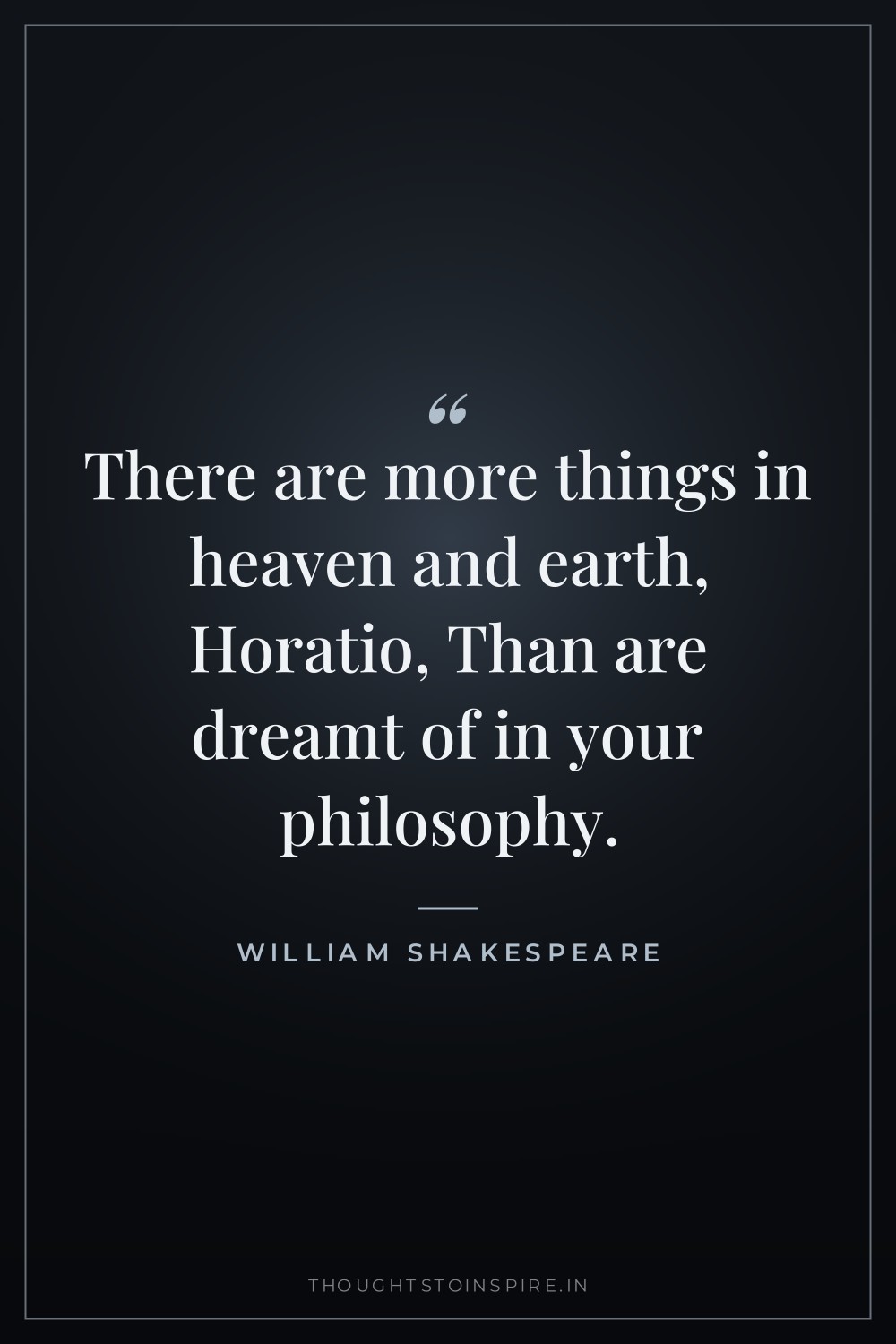
— Hamlet (1601), Act 1, Scene 5
About this quote
हिन्दी में
स्वर्ग और पृथ्वी में ऐसी बहुत-सी चीज़ें हैं, होरेशियो, जिनकी तुम्हारे ज्ञान-शास्त्र ने कल्पना तक नहीं की।
What it means
In 1601 ‘philosophy’ meant natural philosophy — the organised body of learning about how the world works, closer to what we would call science than to a personal outlook. So the claim is narrow and precise: a catalogue of knowledge is incomplete. And the verb is dreamt of, not known — the complaint is that the system has not even imagined these things, let alone ruled on them.
Which is why the usual deployment of the line does not follow from it. It is produced as a trump card in favour of some particular belief, but the sentence names no item. ‘More exists than your list contains’ lends no support to any candidate for the gap — whoever quotes it still has to supply the thing and the evidence for it. The line is worth keeping as a statement about the edges of a body of learning, and for the small sting of your.
What it teaches you
Next time this line arrives in an argument, separate the two claims that have been folded together: that a system of knowledge is incomplete, which the line asserts, and that some specific thing occupies the gap, which it does not. The second claim needs its own evidence, and noticing that is usually the end of the argument.
अर्थ और सीख
शेक्सपियर के समय में ‘philosophy’ का अर्थ था व्यवस्थित ज्ञान, यानी आज के विज्ञान जैसा कुछ — इसलिए यह पंक्ति इतना ही कहती है कि ज्ञान की सूची अधूरी है। इसे आम तौर पर किसी ख़ास विश्वास के पक्ष में सबूत की तरह पेश किया जाता है, जबकि यह किसी चीज़ का नाम ही नहीं लेती। सीख यह है कि ‘सब कुछ ज्ञात नहीं है’ और ‘मेरी बात सही है’ — ये दो अलग दावे हैं, और दूसरे को अपना प्रमाण अलग से देना पड़ता है।
Where it comes from
Hamlet to Horatio, after the ghost. Editions differ between ‘your philosophy’ and ‘our philosophy’ — the text used here reads ‘your’, which makes it a correction aimed at Horatio rather than at both of them.
It is not an argument for credulity. Hamlet spends the play testing the ghost’s claim rather than accepting it, which is the opposite of how the line is normally deployed.