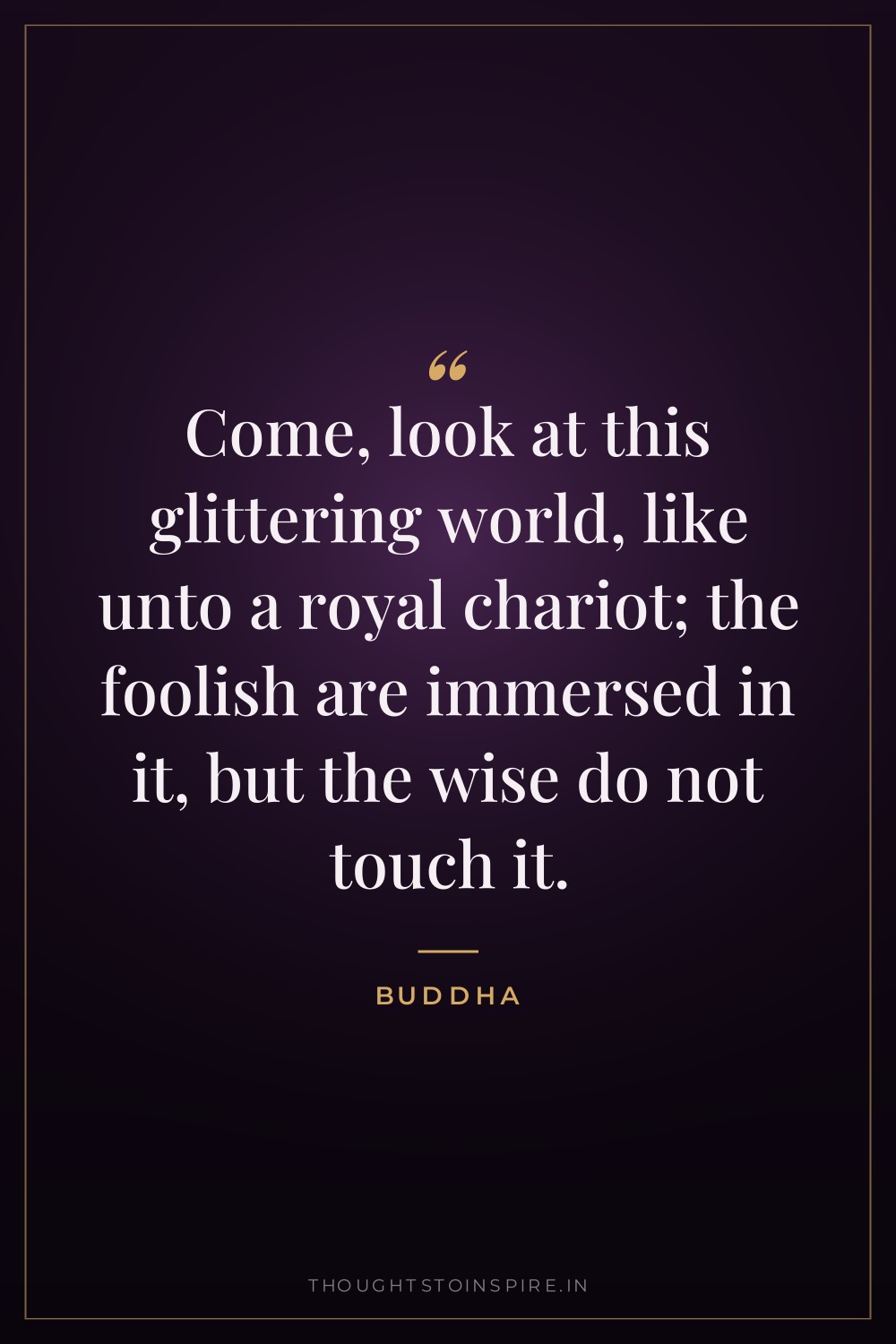
— The Dhammapada, verse 171 (tr. F. Max Müller, 1881)
About this quote
हिन्दी में
आओ, इस चमकती हुई दुनिया को देखो — किसी सजे-धजे राजसी रथ जैसी; मूर्ख इसमें डूब जाते हैं, पर बुद्धिमान इसे छूते भी नहीं।
What it means
The chosen image does a lot of work. A royal chariot is not a natural object — it is manufactured, decorated at expense, built specifically to be looked at and to impress whoever looks. So the verse is not saying the world is worthless; it is saying the glitter is a made surface, and someone made it for an effect.
Then look at the two verbs. The foolish are immersed, which is passive — sunk into it without deciding to be. The wise do not touch. The contrast is not between suffering and enjoying, it is between sinking and not making contact. And the verse opens by saying come, look. It does not ask you to turn your eyes away; it asks for the looking first, and withholds only the touching.
What it teaches you
Follow the verse’s own order. When something pulls at you — a display, an upgrade, a room you have been invited into — look at it long enough to see the decoration as decoration, and ask who arranged it and what the arrangement was meant to produce in you. That look is cheap; it is the touching the verse tells you to hold back.
अर्थ और सीख
यहाँ दुनिया की तुलना राजसी रथ से है — यानी किसी बनाई गई, सजाई गई चीज़ से, जो देखने वाले पर असर डालने के लिए ही तैयार की गई हो। मूर्ख उसमें डूब जाते हैं, बुद्धिमान उसे छूते नहीं — फ़र्क़ भोगने और न भोगने का नहीं, डूबने और न डूबने का है। ध्यान दें कि श्लोक आँखें फेरने को नहीं कहता, बल्कि कहता है — आओ, देखो; पहले ठीक से देखो, फिर हाथ न लगाओ।
Where it comes from
This is verse 171 of the Dhammapada, from the chapter called The World — seeing the world as bubble and mirage, and rising above it.
The Dhammapada is a collection of 423 verses in Pali, among the oldest and most widely read records of the Buddha’s teaching. This English translation is by F. Max Müller (1881), the pioneering Oxford scholar of Indian texts; the verse number is cited with this quote.