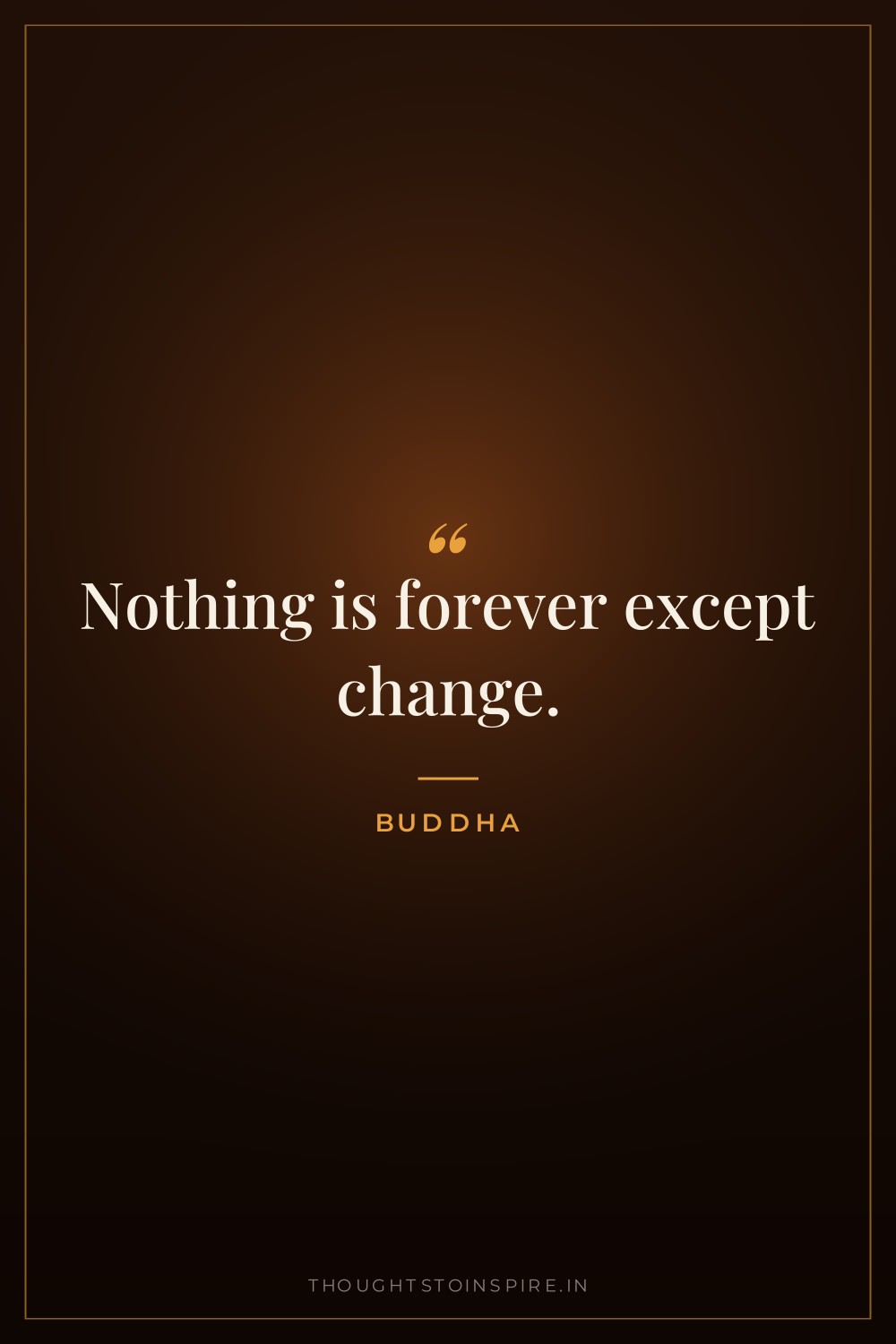
— Modern aphorism on the doctrine of anicca; not in the Canon – cf. Dhammapada 277
About this quote
हिन्दी में
परिवर्तन के सिवा कुछ भी स्थायी नहीं।
What it means
The line is built as a paradox: it announces that nothing lasts and then grants one exception to its own rule. Strictly speaking that exception does not exist — change is not a permanent thing standing apart from other things, it is the name for the fact that no thing holds its shape. The phrasing is memorable precisely because it smuggles a permanence back in.
It is worth keeping for its symmetry, which is also what most quoters ignore. It is nearly always deployed as consolation during a bad stretch, a cousin of this too shall pass. But the sentence contains no filter for good and bad. Applied honestly it says the health, the closeness, and the steady years are leaving on the same terms as the difficulty, which is the half that makes it a teaching rather than a comfort.
What it teaches you
Whenever you reach for this line to get through something unpleasant, spend the same minute applying it to one thing you currently have and would hate to lose. Used only in one direction it is a painkiller; used in both it changes how much attention you give to an ordinary evening that is still available.
अर्थ और सीख
यह वाक्य अपने ही नियम का एक अपवाद बनाता है — कहता है कुछ स्थायी नहीं, सिवाय परिवर्तन के; सच यह है कि परिवर्तन कोई अलग स्थायी वस्तु नहीं, बल्कि किसी भी वस्तु के न टिकने का ही नाम है। लोग इसे केवल दुख के समय सांत्वना के रूप में दोहराते हैं, जबकि इसमें अच्छे और बुरे का कोई भेद नहीं है। पूरी सीख तब मिलती है जब इसे अपने सुख, स्वास्थ्य और अपनों पर भी लागू करें — तभी यह दवा नहीं, दृष्टि बनता है।
Where it comes from
A modern aphorism built on the genuine doctrine of anicca — impermanence — one of the three marks of existence in Buddhist teaching. The canonical formula is ‘all conditioned things are impermanent’ (Dhammapada 277); this snappier phrasing does not appear in the Canon.