— Not Gandhi; closest documented ancestor is Nicholas Klein’s 1918 speech
About this quote
हिन्दी में
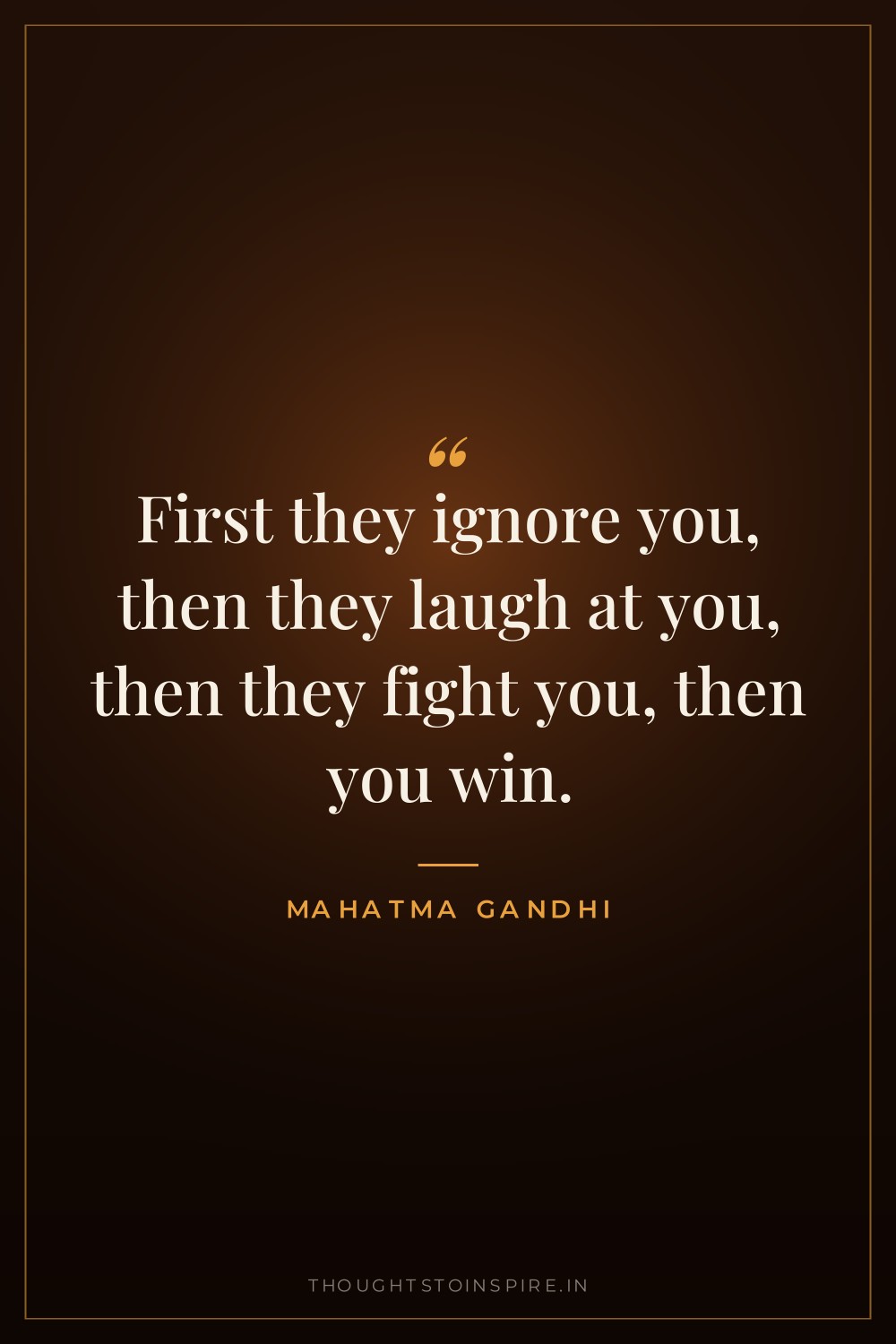
पहले वे तुम्हें अनदेखा करते हैं, फिर तुम पर हँसते हैं, फिर तुमसे लड़ते हैं — और फिर तुम जीत जाते हो।
What it means
This is a four-stage description of how opposition behaves, and three of the four stages are sound observation. Indifference gives way to mockery, and mockery to real resistance, as something grows large enough to be worth the trouble. Each escalation measures how seriously opponents have begun to take you.
The fourth stage does not follow from the first three, and that is where the popular reading goes wrong. Being ignored, laughed at and fought is also the ordinary experience of causes that lost, and treating ridicule as proof of eventual victory is exactly the reasoning that keeps hopeless projects alive for years. The line is worth keeping as a description of the sequence of hostility, not as a guarantee about where the sequence ends.
What it teaches you
Use the first three stages as a gauge of salience, never of correctness: if opponents have moved from not mentioning you to arguing with you, they are now spending resources on you, which tells you that you matter and nothing whatever about whether you are right. Keep a separate test for that — evidence, results, people changing their minds — and do not let the arrival of mockery quietly stand in for it.
अर्थ और सीख
पहले तीन चरण — अनदेखी, उपहास, विरोध — यह सही बताते हैं कि विरोधी आपको धीरे-धीरे कितनी गंभीरता से लेने लगे हैं। लेकिन चौथा चरण इन तीनों से अपने आप नहीं निकलता: हारने वाले आंदोलनों को भी अनदेखा किया गया, उन पर हँसा गया और उनसे लड़ा भी गया। इसलिए उपहास को अपने सही होने का प्रमाण मत मानिए — वह आपकी अहमियत की ख़बर देता है, आपके सही होने की नहीं।
Where it comes from
Almost certainly not Gandhi: this sentence appears nowhere in his Collected Works. The closest documented ancestor is a 1918 speech by the American trade unionist Nicholas Klein: ‘First they ignore you. Then they ridicule you. And then they attack you and want to burn you…’ The Gandhi attribution took hold decades later.