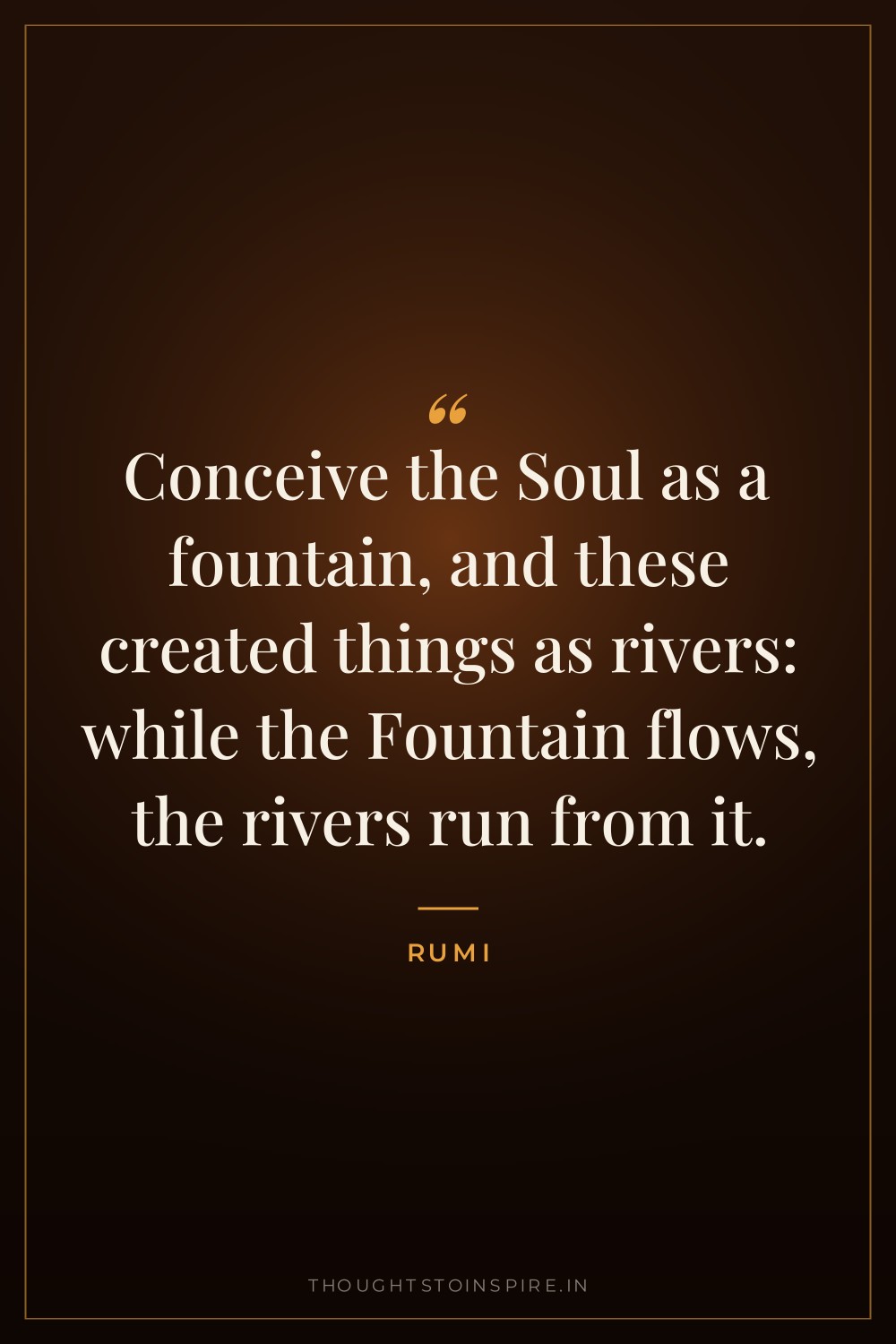
— The Persian Mystics: Jalalu'd-din Rumi (tr. F. Hadland Davis, 1907), "The Water of Eternal Life"
About this quote
हिन्दी में
आत्मा को एक सोते की तरह समझो और इन सारी बनी हुई चीज़ों को नदियों की तरह: जब तक सोता बहता है, नदियाँ उसी से बहती रहती हैं।
What it means
The image is chosen for its tense. While the Fountain flows, the rivers run from it — creation is not an event that happened once and finished, leaving the world to run on its own momentum. It is something still occurring, now, at whatever rate the source supplies. Stop the fountain and there is no river left over.
The picture is also careful not to collapse the two. The river is the same water and it is still a river, with its own banks, course and name. That is what makes this more than a devotional flourish: it grants created things a real existence while denying them an independent one, a harder position to hold than either declaring the world illusory or letting it stand alone.
What it teaches you
Test it where it can be tested: of anything you count as yours — health, attention, the people around you — ask whether it is a stock you are drawing down or a flow you are receiving, because the two call for different handling and most of us manage flows as though they were stocks. The line does not ask you to give up the rivers; it asks you to know what keeps them running.
अर्थ और सीख
रूमी आत्मा को सोता कहते हैं और सारी सृष्टि को उससे निकली नदियाँ। ज़ोर ‘जब तक’ पर है — सृष्टि कोई बीता हुआ काम नहीं, वह अब भी हो रही है; सोता रुके तो नदी बची नहीं रहेगी। सीख यह कि जो अपना लगता है — शरीर, रिश्ते, ध्यान — उसे जमा-पूँजी नहीं, लगातार मिलती धारा मानकर बरतिए।
Where it comes from
From the selection titled The Water of Eternal Life in Rumi’s Masnavi.
Jalalu’d-din Rumi (1207–1273) composed the Masnavi — some 25,000 couplets of stories and teaching — in Konya, in present-day Turkey, after the loss of his teacher Shams of Tabriz. This passage follows the public-domain selections published in The Persian Mystics (1907); the selection title is cited with this quote.