— Songs of Kabir, II.61 (tr. Rabindranath Tagore, 1915)
About this quote
हिन्दी में
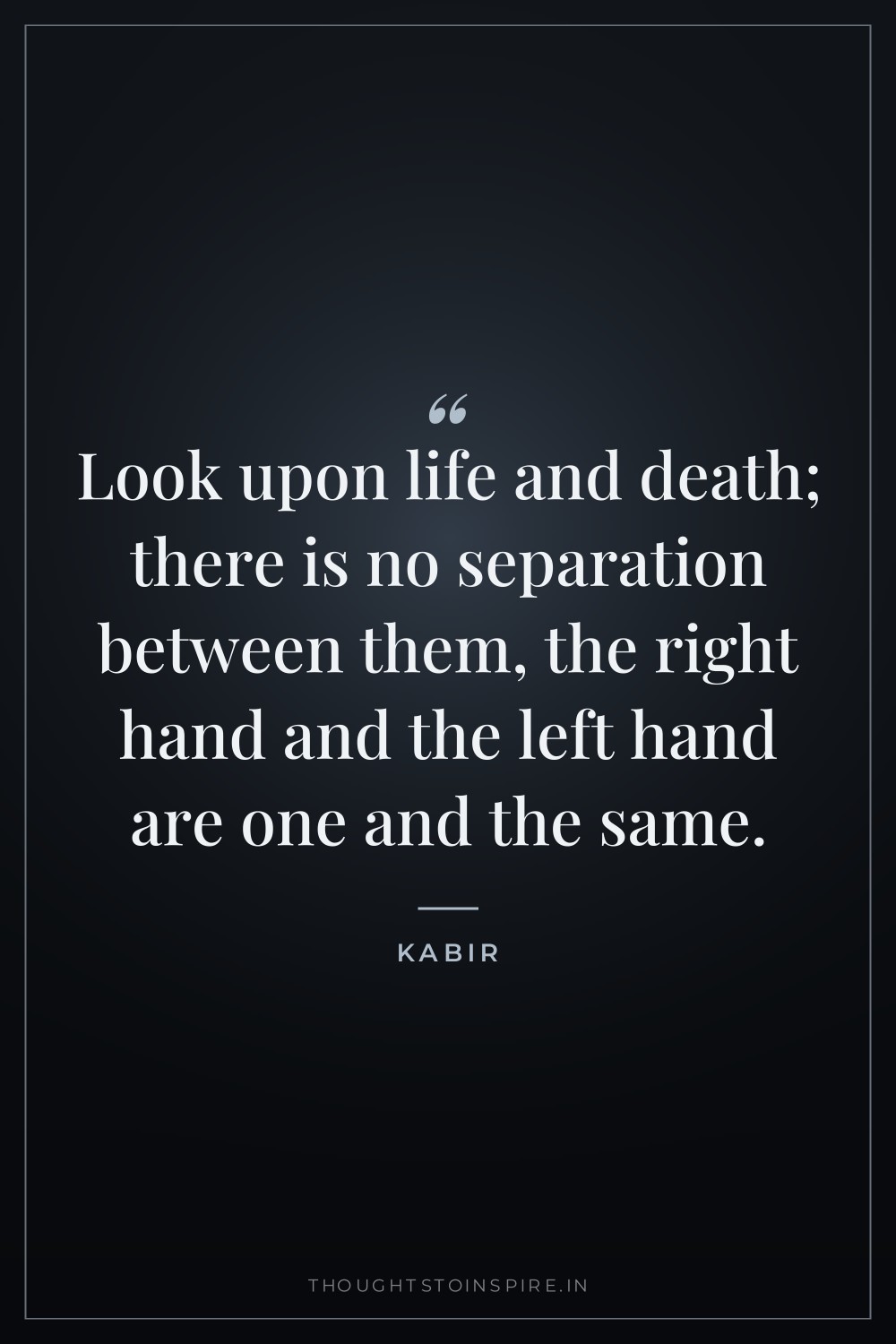
जीवन और मृत्यु को देखो—इन दोनों के बीच कोई अलगाव नहीं; दायाँ हाथ और बायाँ हाथ एक ही हैं।
What it means
The image is chosen with care. Hands are not identical — they are opposite in orientation and you can tell them apart instantly — so the claim is not that life and death feel the same or that one of them is an illusion. It is that they are a matched pair belonging to one body, made to be used together. You do not get to lose one and keep the other.
It circulates as reassurance that death is not real, which is not what the line says. What it denies is separation, a different and harder claim: death is not an event waiting at the far end of life but its other side, in use right now. And the instruction is look upon — an invitation to observe something, not a doctrine to be accepted on trust.
What it teaches you
Notice the grammar you use without thinking: after the scan comes back, once this year is survived, when the funeral is behind us — all of it treating death as an interruption that life resumes after. Kabir asks you to look instead at where the two run together in the ordinary present: things ending while you are still using them, a body losing and replacing itself at the same moment. The place this shows up is in what you postpone, because postponement assumes only one of the hands.
अर्थ और सीख
कबीर जीवन और मृत्यु को दो अलग चीज़ें नहीं, एक ही शरीर के दो हाथ कहते हैं—दायाँ और बायाँ अलग दिखते ज़रूर हैं, पर हैं एक ही देह के, और साथ ही काम आते हैं। ध्यान दीजिए, वे यह नहीं कहते कि मृत्यु झूठ है; वे ‘अलगाव’ से इनकार करते हैं—मृत्यु अंत में खड़ी कोई घटना नहीं, इसी क्षण साथ चल रही दूसरी ओर है। इसका असर सबसे ज़्यादा वहाँ दिखता है जिसे हम टालते हैं, क्योंकि टालना हमेशा एक ही हाथ को गिनकर चलता है।
Where it comes from
From song II.61 of the Songs of Kabir.
Kabir (15th century) was a weaver of Benares whose songs mock every search for God outside one’s own heart; Hindus and Muslims both claimed him, and he refused both. This rendering is from Songs of Kabir, translated by Rabindranath Tagore (1915); the song number is cited with this quote.