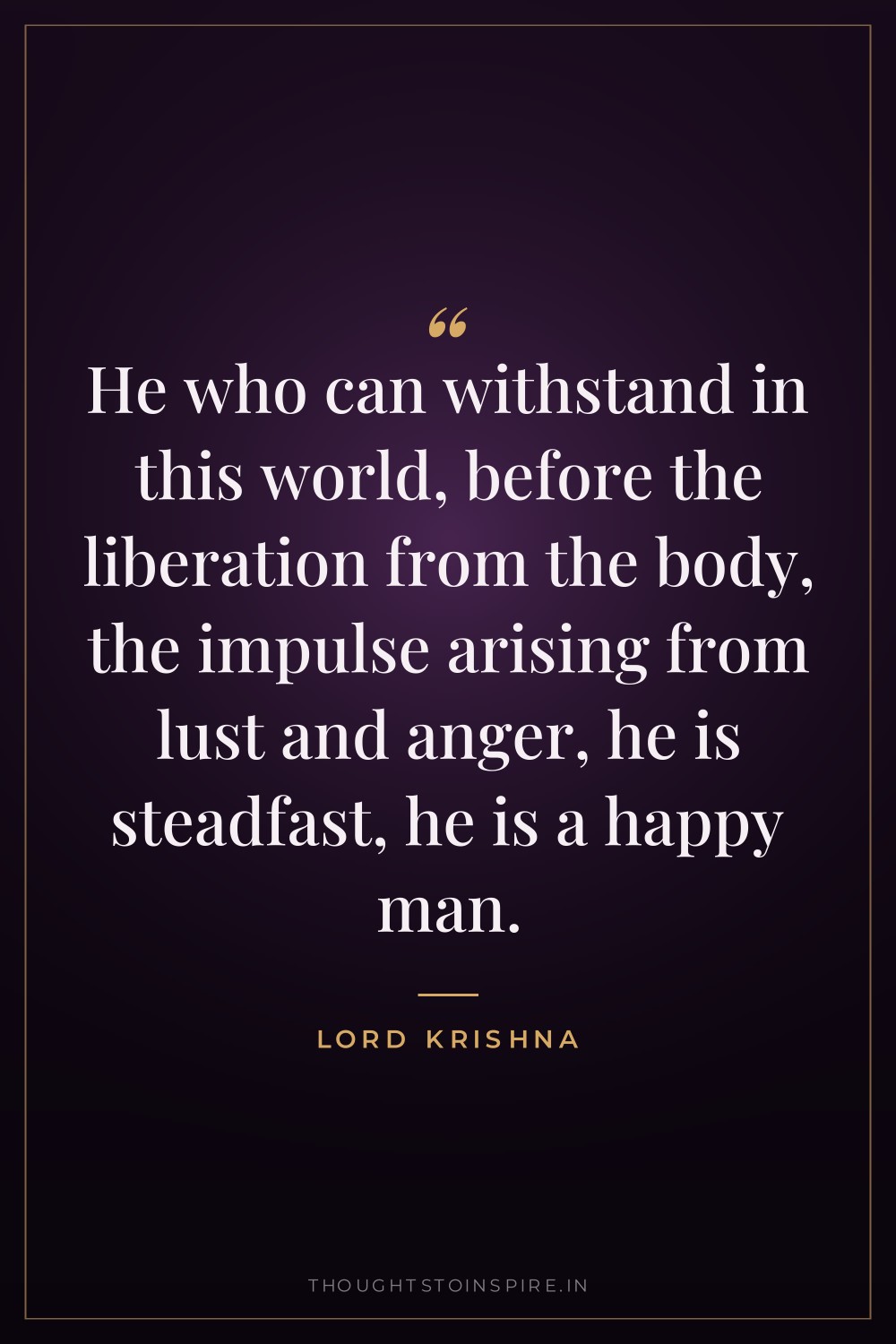
— Bhagavad Gita 5.23 (tr. Swami Swarupananda, 1909)
About this quote
हिन्दी में
जो इस लोक में, शरीर छूटने से पहले ही, काम और क्रोध से उठने वाले वेग को सह सके, वही स्थिर है, वही सुखी है।
What it means
The conditions are the content. In this world and before the liberation from the body fix the test in the present life and the present body — this is not a state described as arriving after death or after some final attainment. And the word is withstand: Krishna does not say the steadfast man has no lust or anger, he says the impulse arises and the man holds out against it.
Worth keeping because it makes happiness a consequence rather than a reward. Quoted as an instruction to control your anger, it turns into one more thing to fail at; as written, it assumes the surge will come to everyone worth addressing, and puts the entire practice in what happens between the impulse and the act.
What it teaches you
Treat the physical onset — heat in the chest, the sentence already forming, the hand reaching for the phone — as the beginning of the test rather than proof you have already lost it. The verse asks only that you outlast the impulse, so measure yourself by the interval: whether a surge passed without being converted into a message, a purchase or a remark. Feeling it is not the failure under discussion.
अर्थ और सीख
कृष्ण यह नहीं कहते कि काम और क्रोध उठें ही नहीं; वे कहते हैं कि जो उनके वेग को सह ले, टिक जाए, वही स्थिर और सुखी है। ‘इसी लोक में, शरीर छूटने से पहले’ — यानी यह परीक्षा अभी, इसी जीवन में है, किसी अगली अवस्था में नहीं। सीख यह है कि आवेग का उठना हार नहीं है; असली बात उस आवेग और कर्म के बीच के अंतराल में है।
Where it comes from
This verse comes from Chapter 5 of the Bhagavad Gita, Karma Sannyasa Yoga (The Yoga of Renunciation) — the reconciliation of renunciation and action: both lead to freedom, but acting without attachment is the more practical path.
The Bhagavad Gita — ‘the Song of the Lord’ — is the dialogue between Krishna and the warrior Arjuna set within the Mahabharata, and one of the most influential spiritual texts ever composed. English translation by Swami Swarupananda (1909), a public-domain rendering from the Sanskrit; the exact chapter and verse are cited with this quote.