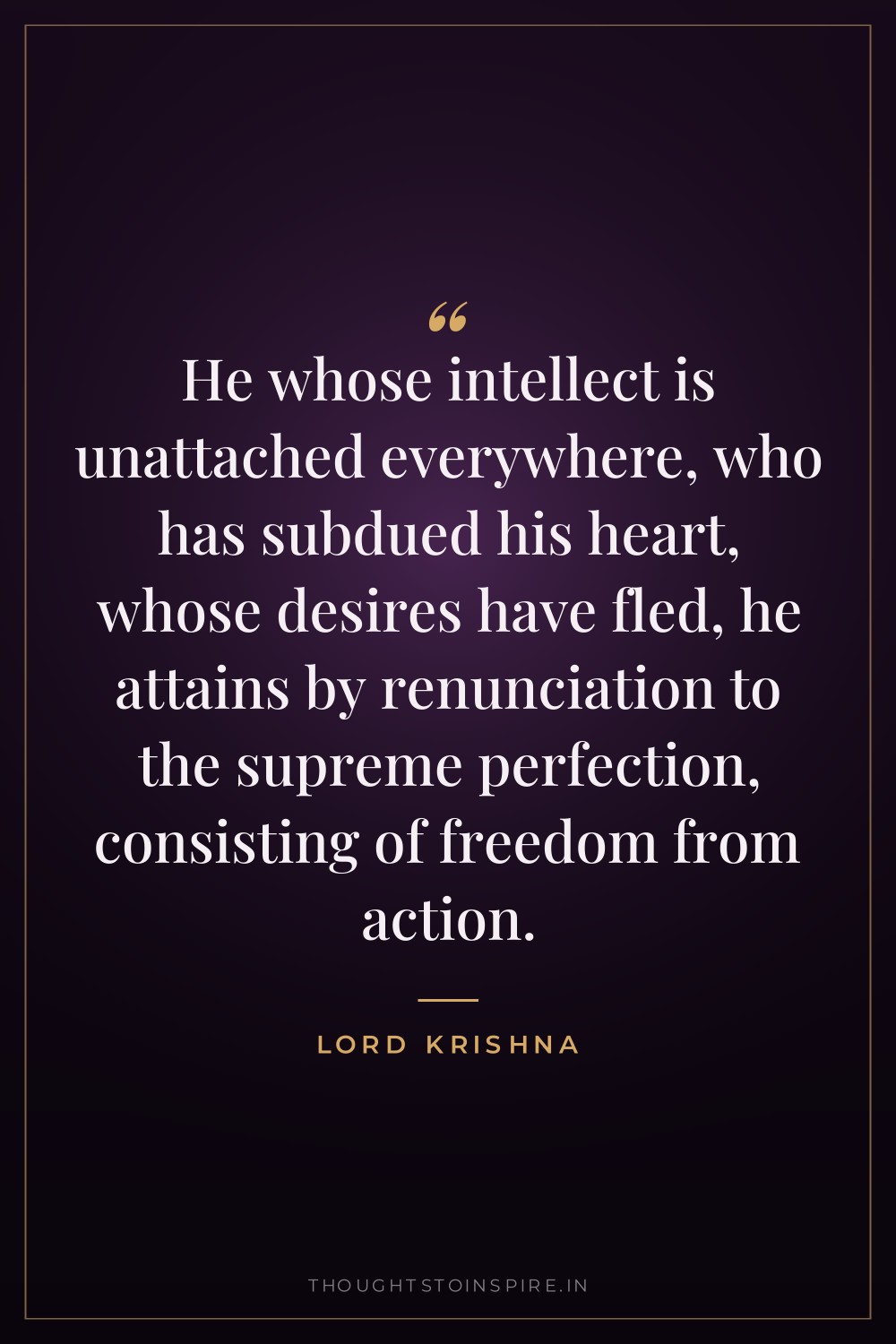
— Bhagavad Gita 18.49 (tr. Swami Swarupananda, 1909)
About this quote
हिन्दी में
जिसकी बुद्धि कहीं भी आसक्त नहीं है, जिसने अपने मन को वश में कर लिया है, जिसकी कामनाएँ मिट चुकी हैं — वही त्याग के द्वारा उस परम सिद्धि को पाता है, जो कर्म से मुक्ति है।
What it means
The line sets three conditions and then names a result. Every one of the three conditions is internal: an intellect that is not attached anywhere, a heart brought under control, desires that have gone rather than been suppressed. Nothing in the list is an external act — no possession given up, no work put down. The result is then described in the translator’s slightly strange phrase, freedom from action.
That phrase is where the popular reading parts from the sentence. It is usually taken to mean stopping work, and ‘freedom from action’ read alone invites that. But the sentence attributes the state to the emptying of desire, not to the ending of activity — it is action that has stopped binding, not action that has stopped. Worth keeping because it supplies a checklist most talk of detachment skips: the test offered here is the condition of the intellect, the heart and the desires, in that order.
What it teaches you
If you are judging your own detachment, notice that this line gives you no credit for what you have given up. Its three tests are whether a particular want has actually gone quiet, whether you can hold attention where you choose, and whether your judgement leans on an outcome. Applied honestly, the checklist usually shows the giving-up was the easy part.
अर्थ और सीख
यह श्लोक तीन भीतरी शर्तें रखता है — अनासक्त बुद्धि, वश में किया हुआ मन, और मिट चुकी कामनाएँ। इनका फल है कर्म से मुक्ति, यानी कर्म छूटना नहीं, बल्कि कर्म का बाँधना बंद हो जाना। सीख यही है कि त्याग की परख इसमें नहीं है कि आपने बाहर क्या छोड़ा, बल्कि इसमें कि भीतर कोई इच्छा सचमुच शांत हुई या नहीं।
Where it comes from
This verse comes from Chapter 18 of the Bhagavad Gita, Moksha Sannyasa Yoga (The Yoga of Liberation) — the summation: true renunciation is of the fruits of work, every person perfects themselves through their own duty, and the teaching ends in the promise ‘grieve not.’
The Bhagavad Gita — ‘the Song of the Lord’ — is the dialogue between Krishna and the warrior Arjuna set within the Mahabharata, and one of the most influential spiritual texts ever composed. English translation by Swami Swarupananda (1909), a public-domain rendering from the Sanskrit; the exact chapter and verse are cited with this quote.