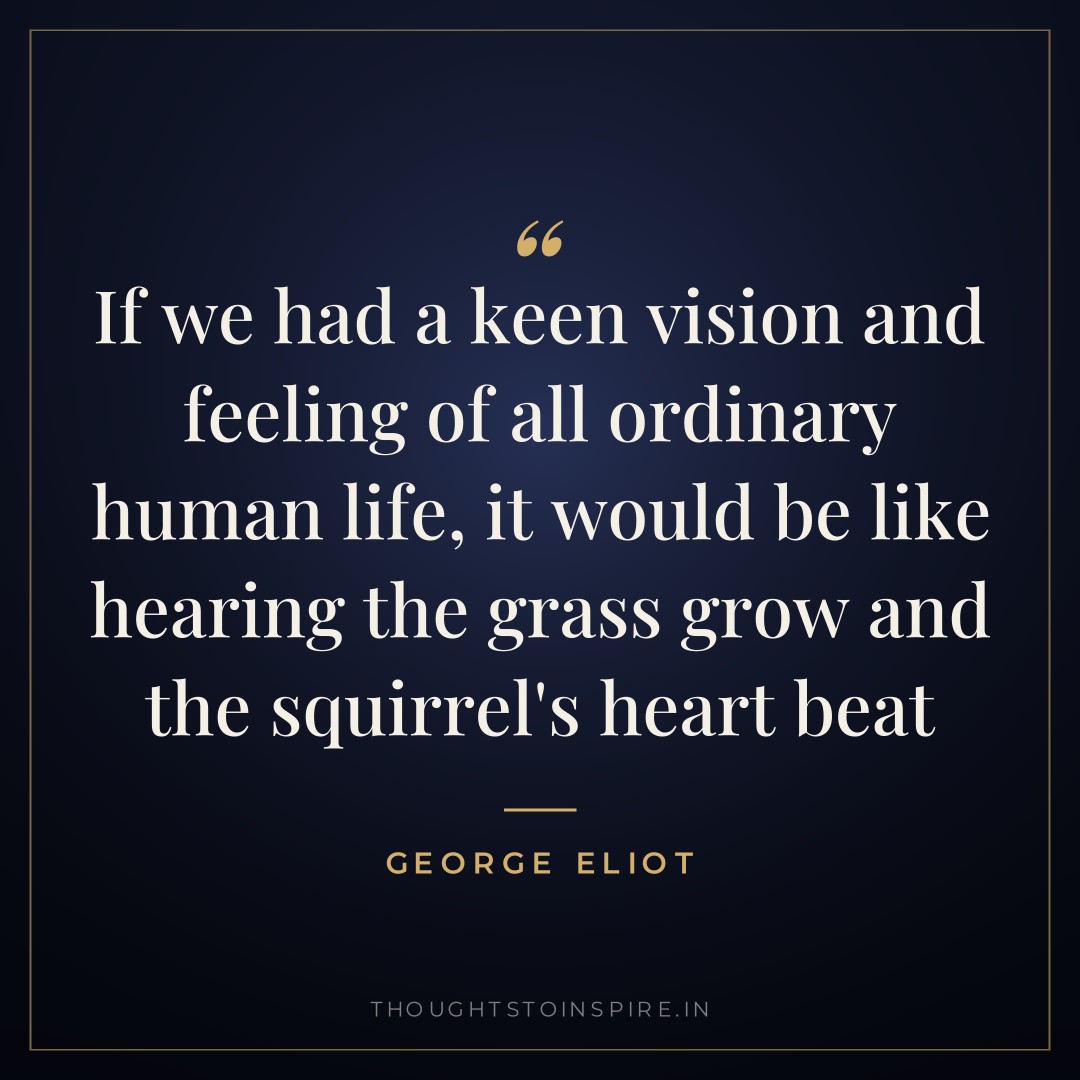
— Middlemarch (1872), Chapter 20
About this quote
हिन्दी में
अगर हमारे पास साधारण मानव जीवन को पूरी तरह देख और महसूस कर पाने की पैनी शक्ति होती, तो यह घास के उगने और गिलहरी के दिल की धड़कन को सुन लेने जैसा होता।
What it means
The claim is that failing to feel other people is a limit of perception, not a defect of character. Note the two nouns: vision and feeling. Eliot is not asking for sympathy on top of information; she is describing a single faculty that would deliver both at once, and she treats our lack of it as a physical fact about the equipment.
The chosen images do the argument’s real work. Grass growing and a squirrel’s heart are not dramatic sounds — they are continuous, everywhere, and going on right now. What would be unendurable is not the intensity of other people’s lives but the fact that they never stop. That is a sharper and stranger thing than the quotation’s usual use as a plea to be more sensitive.
What it teaches you
Treat sustained attention to another person as something with a cost, and budget it like one. After an afternoon of genuinely following someone’s situation, the flatness you feel afterwards is the predictable price of the faculty Eliot describes, not proof that you are cold. The practical form of this is to attend hard to a few people rather than thinly to everyone, and to stop reading exhaustion as moral failure.
अर्थ और सीख
एलियट कह रही हैं कि दूसरों का जीवन पूरी तरह महसूस न कर पाना हमारी कठोरता नहीं, हमारी इंद्रियों की सीमा है। अगर सब कुछ सुनाई देने लगे तो वह घास उगने और गिलहरी की धड़कन जैसी लगातार चलती रहने वाली आवाज़ें होंगी — भयानक इसलिए नहीं कि तेज़ हैं, बल्कि इसलिए कि कभी रुकती नहीं। सीख यह कि किसी के साथ सच में ध्यान से जुड़ना थका देता है; इसलिए थोड़े लोगों के साथ गहराई से जुड़िए, और उस थकान को अपनी कमी मत समझिए।
Where it comes from
Eliot’s argument against the kind of attention her own novel demands. If we truly felt all ordinary human life, she says, the noise would be unbearable — and so we are wadded with stupidity for our own protection.
It is a startling admission from a writer whose project was to make provincial lives feel enormous. She knew what she was asking of readers.