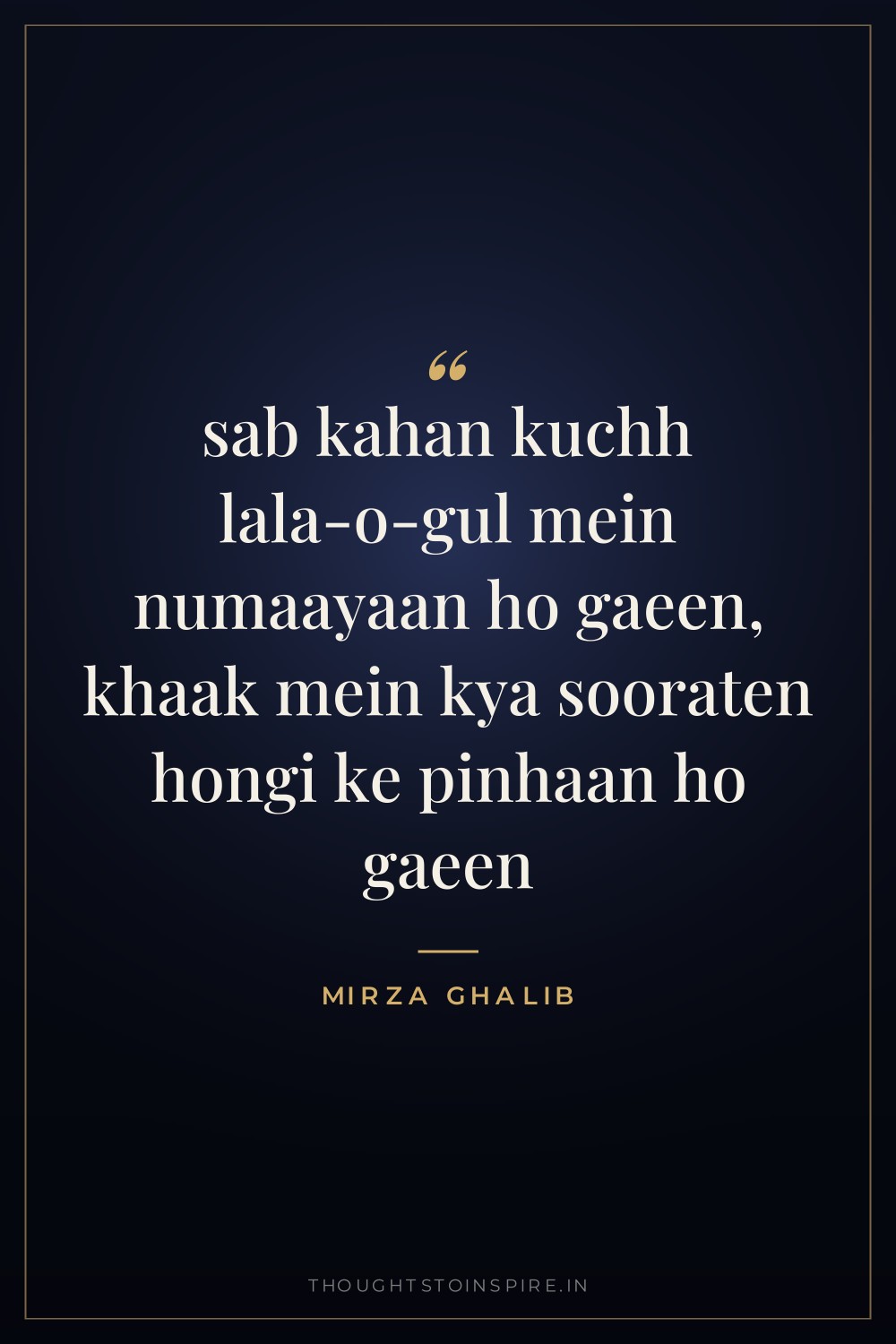
— Divan-e-Ghalib, from the ghazal "sab kahan kuchh lala-o-gul"
About this quote
देवनागरी
सब कहाँ कुछ लाला-ओ-गुल में नुमायाँ हो गईं
ख़ाक में क्या सूरतें होंगी कि पिन्हाँ हो गईं
English
Not all — only some return as tulips and roses. What faces there must be, hidden still in the dust!
What it means
Ghalib looks at flowers and sees the beloved dead, partially returned. The earth holds more beauty than it releases — a couplet that turns every garden into a graveyard and every graveyard into a garden.
The couplet opens by cancelling a sentence we never heard: sab kahan — hardly all — as if answering a comfortable thought already in the air, that the dead come back as flowers. Then it sets numaayaan against pinhaan, manifest against hidden, an exact pair that turns the whole thing into a ratio in which the visible garden is the small remainder. The second line is an exclamation, not a question: it does not ask what lies in the dust, it marvels at a beauty that will never be shown. Read as consolation about rebirth, it loses its point, which is the size of what stays under.
What it teaches you
Assume that what you can see of anything is the published fragment. Applied to a person, it means the version you have met is the part that surfaced; applied to a field or a city or a family, it means the famous names are the exception and not the sample. Before you conclude that you have someone’s measure, ask what would have had to happen for the rest of them to become visible to you.
अर्थ और सीख
जो फूल खिलते हैं, वो ख़ाक में छुपी सूरतों की एक झलक भर हैं — कितने चेहरे अब भी मिट्टी में पिन्हाँ होंगे। मौत और सुंदरता का ऐसा संगम दुर्लभ है।
जो दिख रहा है वह पूरा नहीं, बहुत थोड़ा हिस्सा है। किसी आदमी या किसी नुक़सान को उसके दिखने वाले हिस्से से मत नापिए।
Where it comes from
An authentic couplet from the Divan-e-Ghalib, the collected Urdu ghazals of Mirza Asadullah Khan Ghalib (1797–1869), from the ghazal beginning “sab kahan kuchh lala-o-gul”. Transliteration and English rendering are our own.