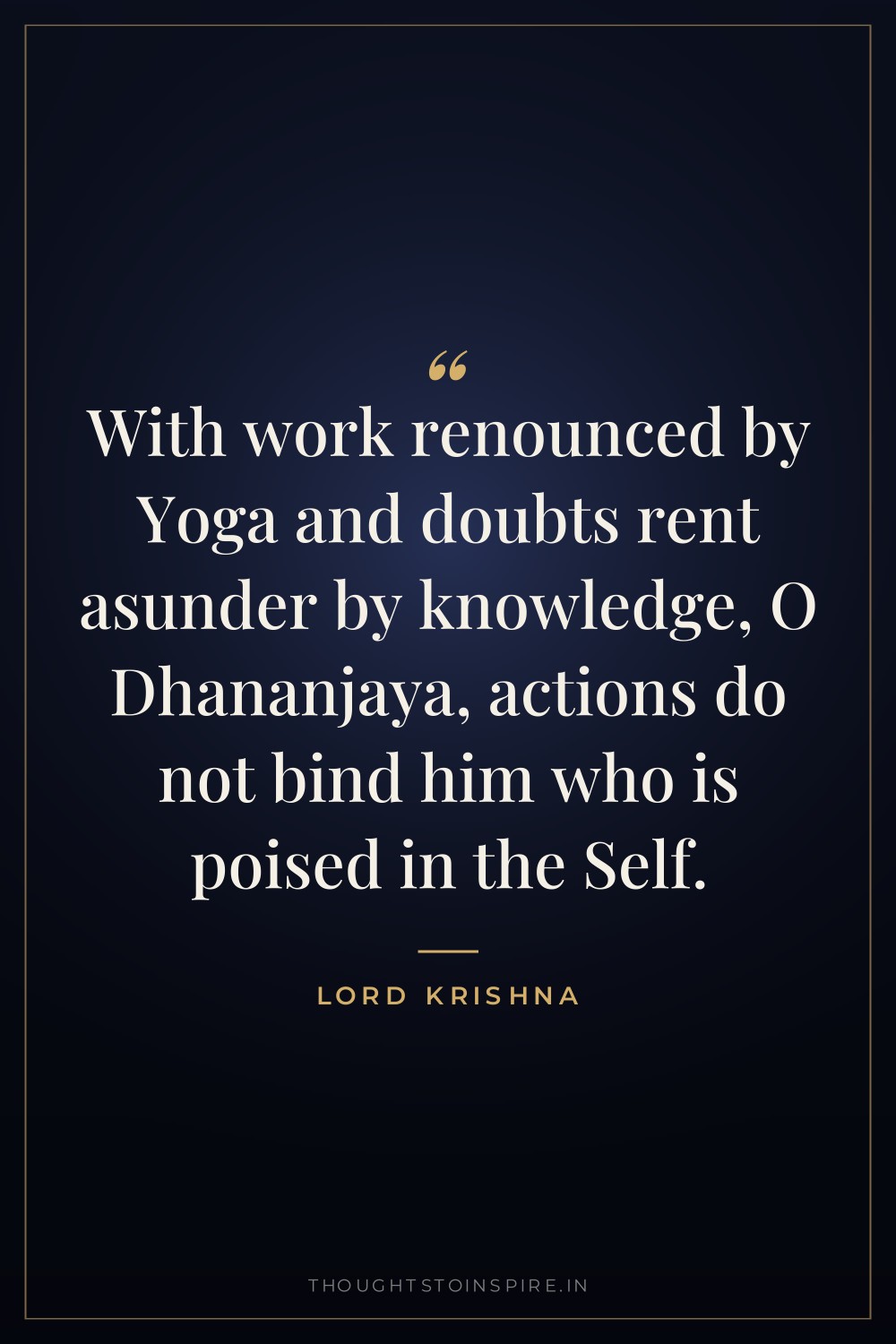
— Bhagavad Gita 4.41 (tr. Swami Swarupananda, 1909)
About this quote
हिन्दी में
हे धनंजय! योग के द्वारा जिसने कर्म का त्याग कर दिया और ज्ञान से जिसके संशय छिन्न हो गए, आत्मा में स्थित उस पुरुष को कर्म नहीं बाँधते।
What it means
Two bondages are named, and each gets its own instrument. Yoga is what renounces the work — the claim on its fruit — while knowledge is what cuts doubt apart. Doubt is being treated as a separate chain requiring a separate tool, which is why more discipline or more devotion does not touch it.
The conclusion is precisely worded: actions do not bind him. They do not stop. Nothing here asks for withdrawal from work; what changes is that the work loses its grip on the one doing it, and that holds only for someone poised in the Self. Taken as a general assurance that actions no longer matter, the line loses all three of its conditions.
What it teaches you
Notice that doubt is given its own remedy here. If you are unsettled about whether the work is worth doing, or whether any of this is true, more effort and more surrender will not resolve it — that is a question to be settled by study, argument and asking someone who actually knows, which is what knowledge is doing in this line. Keep working while you settle it; the verse nowhere asks you to stop.
अर्थ और सीख
यहाँ दो अलग बंधनों के दो अलग उपाय बताए गए हैं: योग से कर्म का, यानी फल पर दावे का त्याग, और ज्ञान से संशय का नाश। इसके बाद ही आत्मा में स्थित व्यक्ति को कर्म नहीं बाँधते — कर्म रुकते नहीं, बस बाँधना बंद कर देते हैं। सीख यह कि संदेह को अधिक परिश्रम से नहीं, समझ और अध्ययन से सुलझाइए, और तब तक काम चलता रहे।
Where it comes from
This verse comes from Chapter 4 of the Bhagavad Gita, Jnana Karma Sannyasa Yoga (The Yoga of Knowledge and Renunciation of Action) — how divine teaching descends age after age, and how knowledge burns the bonds of action ‘as fire reduces wood to ashes.’
The Bhagavad Gita — ‘the Song of the Lord’ — is the dialogue between Krishna and the warrior Arjuna set within the Mahabharata, and one of the most influential spiritual texts ever composed. English translation by Swami Swarupananda (1909), a public-domain rendering from the Sanskrit; the exact chapter and verse are cited with this quote.