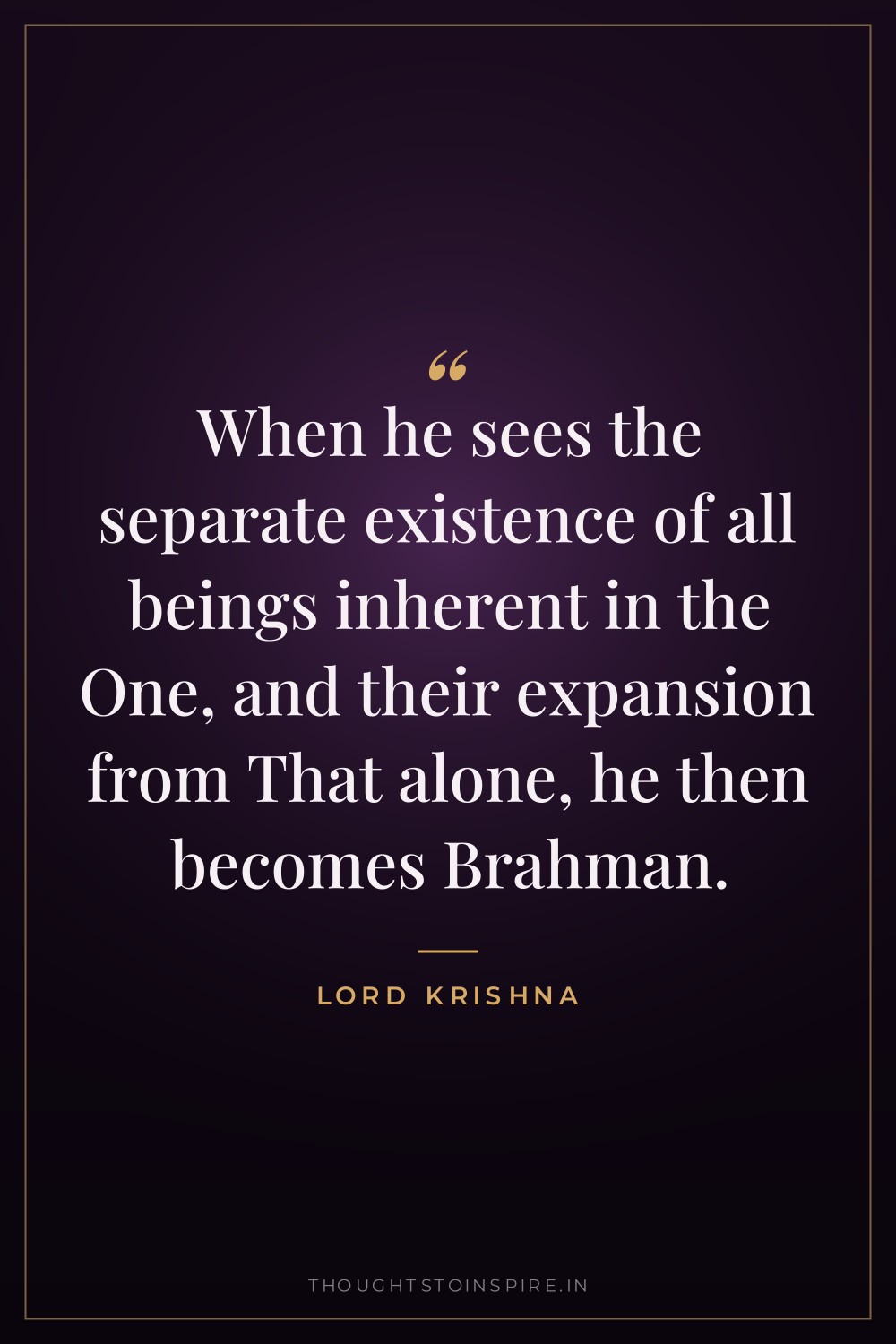
— Bhagavad Gita 13.30 (tr. Swami Swarupananda, 1909)
About this quote
हिन्दी में
जब वह समस्त प्राणियों के पृथक् अस्तित्व को एक ही में स्थित देखता है, और उसी एक से उनका विस्तार हुआ देखता है, तब वह ब्रह्म को प्राप्त होता है।
What it means
The line is usually quoted as if it said that difference is an illusion. It says almost the opposite. The separate existence of all beings is kept intact — the many are not dissolved into the One, they are located in it, and their spreading out is traced back to a single source. What changes is not the count of things in the world but the account of where they came from.
What makes it worth keeping is the grammar of the second half: he then becomes Brahman. The becoming follows the seeing. No act, offering or austerity is named as the qualifying step — the condition stated here is a way of perceiving, and the result is put in the same sentence as its cause rather than promised for later.
What it teaches you
The next time you explain someone by what separates them from you — their politics, their community, their temperament — check whether your explanation contains any shared origin at all, or whether it stops at the difference. This verse does not ask you to stop noticing that people are separate; it asks whether your account of them terminates in something common or terminates in the division itself.
अर्थ और सीख
यह श्लोक कहता है कि सब प्राणी अलग-अलग तो हैं, पर उनका वह अलग-अलग होना एक ही तत्त्व में टिका है और उसी से फैला है — भेद मिटता नहीं, उसका मूल दिखने लगता है। ध्यान दीजिए कि यहाँ ‘ब्रह्म हो जाना’ किसी कर्म या साधना के बाद नहीं, इसी देखने के साथ जुड़ा है। सीख यह है कि दूसरों को समझाते समय केवल भेद गिनाकर रुक जाना अधूरा देखना है।
Where it comes from
This verse comes from Chapter 13 of the Bhagavad Gita, Kshetra Kshetrajna Vibhaga Yoga (The Field and its Knower) — the analysis of body and spirit: the field of experience, the knower who witnesses it, and the light beyond darkness dwelling in every heart.
The Bhagavad Gita — ‘the Song of the Lord’ — is the dialogue between Krishna and the warrior Arjuna set within the Mahabharata, and one of the most influential spiritual texts ever composed. English translation by Swami Swarupananda (1909), a public-domain rendering from the Sanskrit; the exact chapter and verse are cited with this quote.