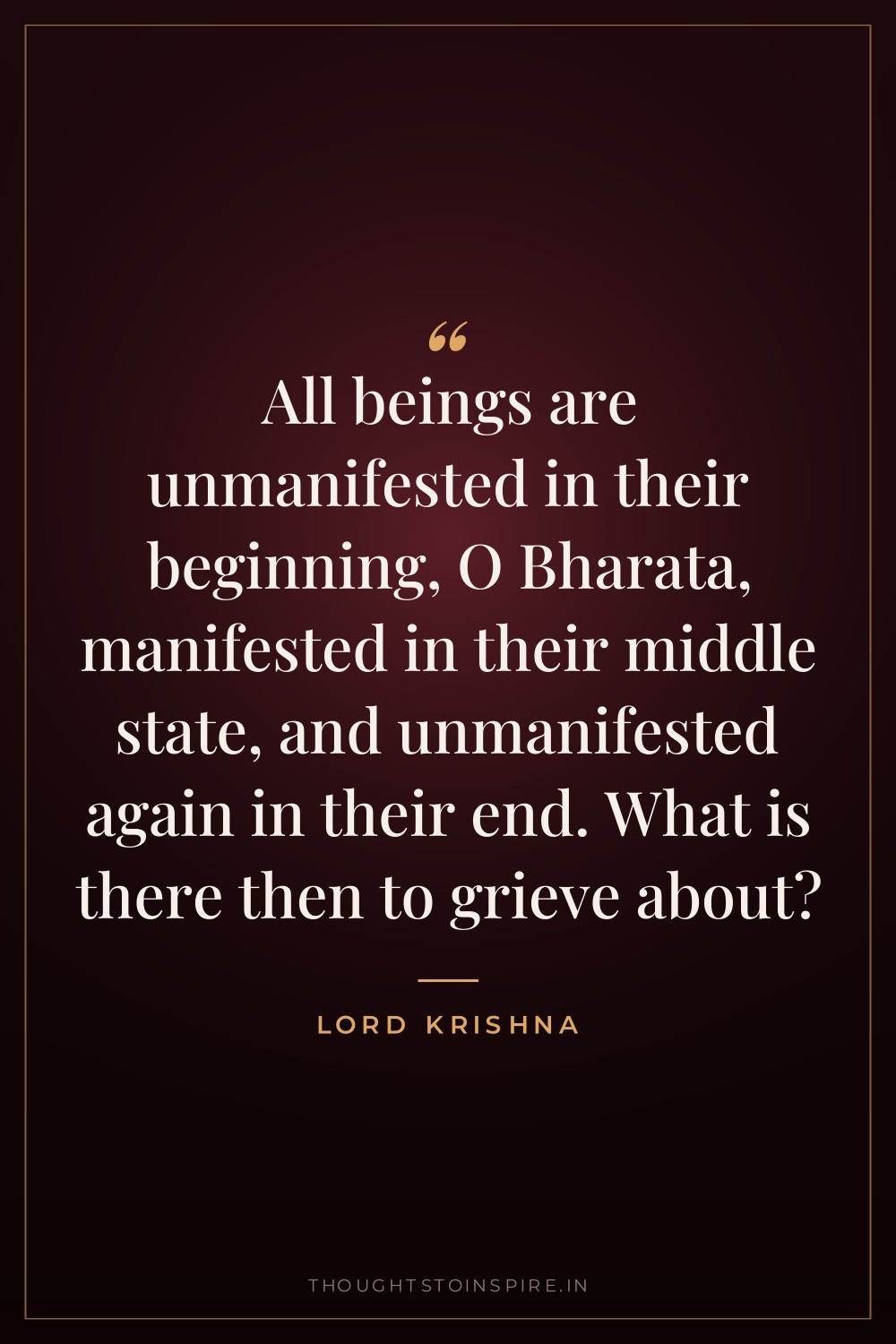
— Bhagavad Gita 2.28 (tr. Swami Swarupananda, 1909)
About this quote
हिन्दी में
हे भारत, सभी प्राणी आरम्भ में अव्यक्त होते हैं, बीच की अवस्था में व्यक्त, और अन्त में फिर अव्यक्त हो जाते हैं। फिर शोक किस बात का?
What it means
The argument is structural rather than consoling. Krishna lays out three states in sequence — unmanifest, manifest, unmanifest — which makes visibility the middle term and the exception, not the normal condition of a being. Death, on this accounting, is not the arrival of nothing; it is a return to exactly the condition the being was in before you ever encountered it.
The closing question is doing the work, and it is a question rather than a denial. It does not say grief is forbidden or that feeling it is a failure; it asks what its object is, given the sequence just laid out. Read closely, the verse does not say beings cease — it says they stop being manifest, which is a claim about what can be perceived rather than about what exists, and that is a narrower and stranger consolation than the usual everything is temporary gloss.
What it teaches you
In grief, try to locate which of the three states the pain is attached to, because almost always it is the disappearance of the visible — the voice, the room, the daily fact of someone. The verse’s own test is worth applying honestly: you did not grieve during the first unmanifest stretch, before that person appeared, and noticing the asymmetry does not remove the loss but does show you how much of it concerns your access to them rather than them.
अर्थ और सीख
कृष्ण यहाँ तीन अवस्थाएँ गिनाते हैं — आरम्भ में अव्यक्त, बीच में व्यक्त, अन्त में फिर अव्यक्त — यानी दिखाई देना ही अपवाद है, नियम नहीं। ध्यान दीजिए, श्लोक यह नहीं कहता कि प्राणी मिट जाते हैं; कहता है कि वे अप्रकट हो जाते हैं, जो देखने की सीमा की बात है, होने की नहीं। अंत का प्रश्न शोक को मना नहीं करता, बस पूछता है कि शोक किस चीज़ का है — और अक्सर उत्तर यही निकलता है कि जो दिखना बंद हुआ, उसी का।
Where it comes from
This verse comes from Chapter 2 of the Bhagavad Gita, Sankhya Yoga (The Yoga of Knowledge) — the Gita in miniature: the immortality of the Self, the discipline of equanimity, and the first statement of acting without attachment to results.
The Bhagavad Gita — ‘the Song of the Lord’ — is the dialogue between Krishna and the warrior Arjuna set within the Mahabharata, and one of the most influential spiritual texts ever composed. English translation by Swami Swarupananda (1909), a public-domain rendering from the Sanskrit; the exact chapter and verse are cited with this quote.