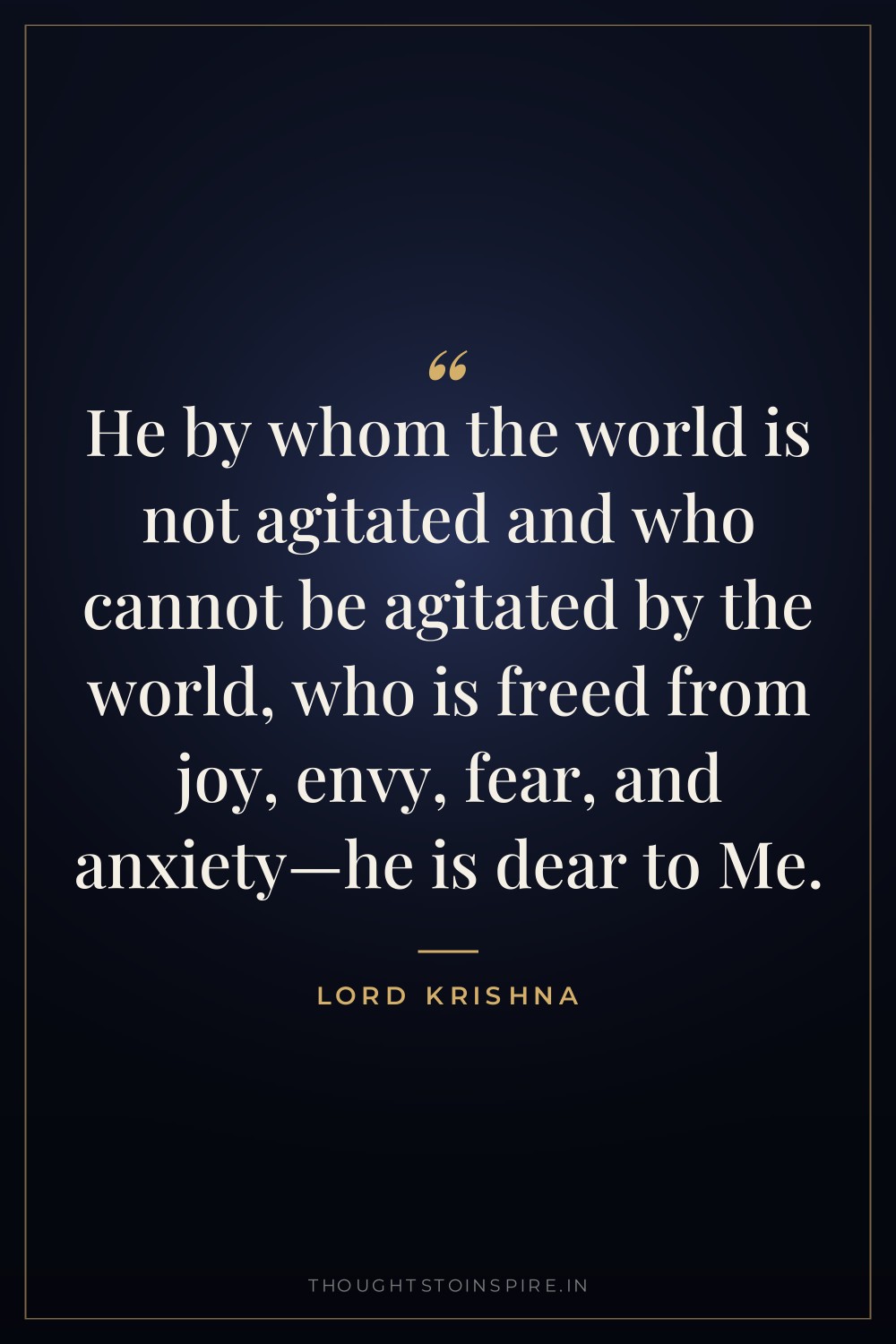
— Bhagavad Gita 12.15 (tr. Swami Swarupananda, 1909)
About this quote
हिन्दी में
जिससे संसार विचलित नहीं होता और जो संसार से विचलित नहीं होता, जो हर्ष, ईर्ष्या, भय और उद्वेग से मुक्त है — वह मुझे प्रिय है।
What it means
The devotee here is defined almost entirely by absences, and one item on the list should stop a reader: joy is placed alongside envy, fear and anxiety. The grouping treats the upward spike and the downward one as the same event — a mind moved from outside itself. What is being described is not someone who feels nothing, but someone whose weather does not change because somebody else’s did.
It is worth noticing what is promised at the close. Not liberation, not power, not a reward in the usual sense: the sentence ends on he is dear to Me, which is a statement about relationship. In a chapter weighing how God is best approached, the standard finally offered turns out to be a temperament rather than a practice — and a temperament partly measured by what it does to the people nearby.
What it teaches you
Watch for the version of yourself that needs the news to be good: a mood that lifts at a message and drops at a delayed reply is one instability showing both its faces, and this verse counts the lift as part of the condition rather than relief from it. For the other half of the line there is a plain test — notice whether people adjust when you enter a room, whether they read your face before deciding what to say, because that adjustment is precisely the agitation the verse says the devotee does not cause.
अर्थ और सीख
यह श्लोक भक्त को उन बातों से परिभाषित करता है जो उसमें नहीं हैं — न वह किसी को विचलित करता है, न स्वयं विचलित होता है; और ध्यान दीजिए कि हर्ष को भी ईर्ष्या, भय और चिंता के साथ ही गिना गया है। यानी बाहर की ख़बर से उछलना और बैठ जाना, दोनों एक ही अस्थिरता के दो रूप हैं। सीख: उस मन को पहचानिए जिसे अच्छी ख़बर चाहिए ही चाहिए; और यह भी देखिए कि आपके कमरे में आते ही लोग सँभलने तो नहीं लगते।
Where it comes from
This verse comes from Chapter 12 of the Bhagavad Gita, Bhakti Yoga (The Yoga of Devotion) — the chapter of devotion, ending with Krishna’s portrait of the devotee he holds dear — even-minded, without malice, agitating no one.
The Bhagavad Gita — ‘the Song of the Lord’ — is the dialogue between Krishna and the warrior Arjuna set within the Mahabharata, and one of the most influential spiritual texts ever composed. English translation by Swami Swarupananda (1909), a public-domain rendering from the Sanskrit; the exact chapter and verse are cited with this quote.