— Divan-e-Ghalib, from the ghazal "koi ummeed bar nahin aati"
About this quote
देवनागरी
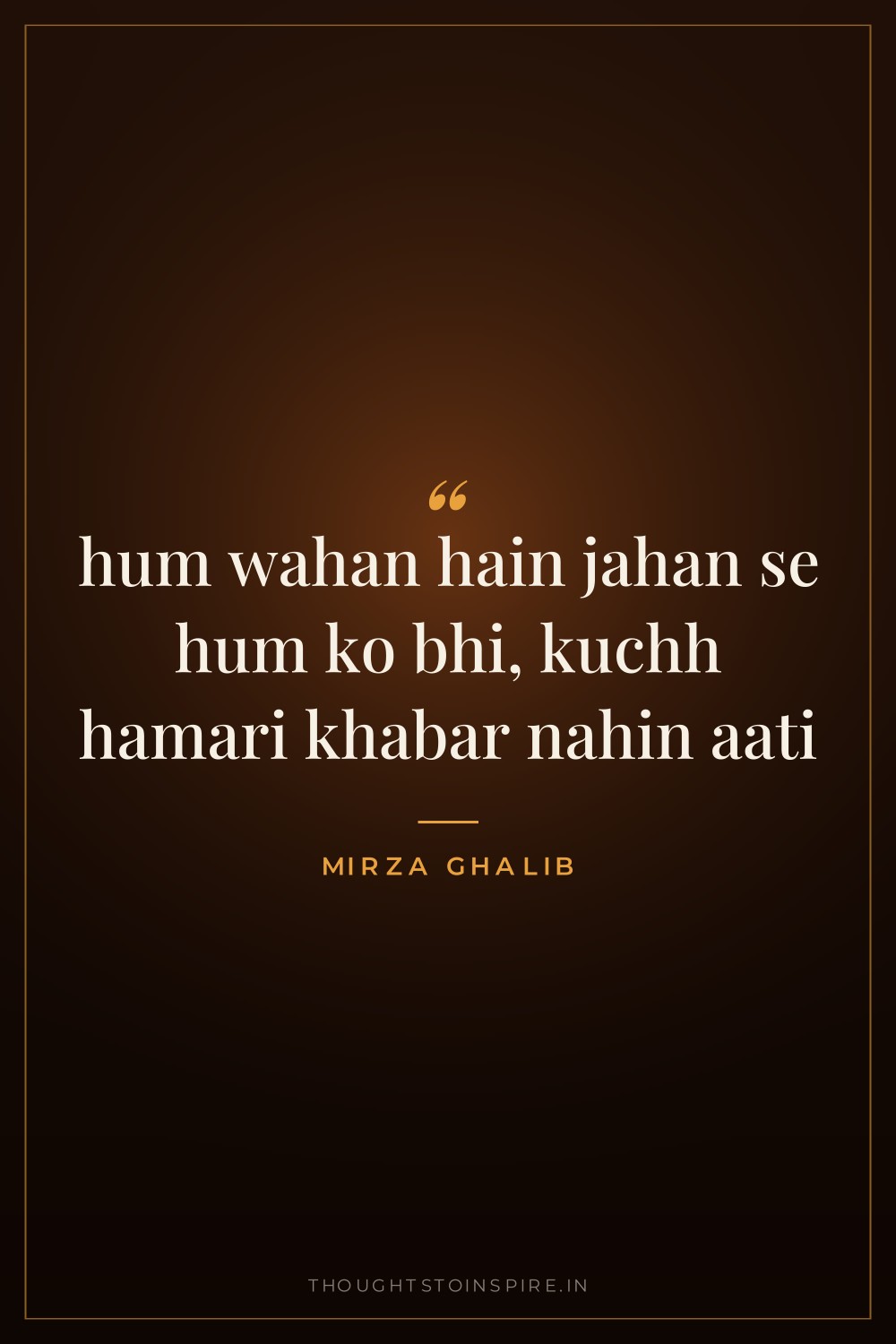
हम वहाँ हैं जहाँ से हम को भी
कुछ हमारी ख़बर नहीं आती
English
I have reached a place from which even I receive no news of myself.
What it means
The furthest coordinates of grief — an estrangement so complete that the self loses track of the self. Centuries before psychology named dissociation, Ghalib mapped it in two lines.
Everything hangs on khabar — news, dispatch, word sent from somewhere — which turns the self into a distant province that has stopped filing reports. The speaker is at once the place and the one waiting for word from it. Hum ko bhi, ‘even to me’, is the sharp bit: it implies others get no news either, so this is not secrecy or withholding but plain absence of anything to send. The couplet is often lifted as a boast of mystical self-annihilation; the vocabulary is administrative, not ecstatic, and reads more simply as a report of being unreachable.
What it teaches you
Take ‘I don’t know how I am’ as information rather than evasion. When someone in a bad stretch cannot describe their state, pressing for a summary asks a closed office to issue a statement; sit with them, offer specifics they can accept or decline, and stop requesting the report. Apply the same to yourself — if there is no news, say there is no news instead of assembling a tidy answer you do not have. Noting the blankness accurately is more use to a friend or a doctor than a manufactured account.
अर्थ और सीख
ग़म की वो हद जहाँ इंसान को ख़ुद अपनी ख़बर नहीं रहती। अपने ही आप से बिछड़ जाने का ऐसा बयान और कहीं नहीं मिलता।
अगर कोई अपना हाल नहीं बता पा रहा, तो यही उसका हाल है — उससे रिपोर्ट मत माँगिए, चुपचाप साथ बैठिए। और ख़ुद के लिए भी: जवाब न हो तो गढ़ा हुआ जवाब मत दीजिए।
Where it comes from
An authentic couplet from the Divan-e-Ghalib, the collected Urdu ghazals of Mirza Asadullah Khan Ghalib (1797–1869), from the ghazal beginning “koi ummeed bar nahin aati”. Transliteration and English rendering are our own.